Outdoor Sports Bag Manufacturer in China
Leave a message
Outdoor Sports Bag Manufacturer in China: Shared Production Lines, Mixed Containers, and MOQ Aggregation
Every buyer with four bag categories eventually asks the same question: can one factory make all of them, and can one container carry all of them. The honest answer is that the two questions have different answers. Some products share a production line because they share a construction. Others share a container because a container does not care what is inside it. Confusing the two is how programs end up with eight suppliers, four shipments, and a landed cost nobody can explain.
This piece works through the four mechanics behind a mixed program: which products genuinely share a line, how a container is planned once carton cube replaces unit count, where shared materials cut cost without cutting specification, and how MOQ aggregation is negotiated rather than wished for. Figures are given as ranges with the caveat that freight rates and fabric quotes move; the arithmetic is the durable part.
What Actually Shares a Production Line
Factories organize around construction rather than product names. A backpack with a suspension system needs a framesheet, padded straps, and a hip belt, which means pattern work, foam molding, and a sewing sequence that a tote bag never touches. A welded dry bag needs high-frequency equipment and film handling, a different building in most plants. A small pouch needs flat-bed sewing and almost nothing else.
That produces four practical families. Suspension builds, hiking and trekking packs, need the most tooling and the longest sampling. Large-opening soft bags, duffels and dry bags, split again by closure: a sewn duffel shares more with a backpack than with a welded dry bag. Small accessories, waist packs, pouches, and organisers, are the easiest to run in small quantities and can be absorbed by almost any plant. Lightweight packable items, folding bags and rain covers, fill volume cheaply and share cutting with accessories.
The supplier structure that follows is usually one main factory plus one specialist: the main plant takes suspension builds, accessories, and packables, while a second plant handles welded closures. That is a smaller network than one supplier per SKU and a more honest one than a single factory claiming everything. Buyers evaluating an outdoor sports bag manufacturer china program should ask which of the four families runs on which line, and expect the answer to name at least two.
Mixed-Container Planning: Carton Mix, Sequence, and CBM
Bags are volume cargo, which is the first thing any outdoor sports bag manufacturer china program has to accept. A 40 foot high cube fills at 18 to 22 tonnes against a 26.5 tonne limit, so the container always cubes out before it weighs out, which means the plan is built from cubic meters and never from pieces. Working capacities are 25 to 28 CBM for a 20GP, 54 to 60 for a 40GP, and 65 to 68 for a 40HQ, planned at roughly 88 percent to leave room for corrugation, stacking limits, and bracing.
Carton cube varies more than most buyers expect, and it varies against intuition. A 56 to 75 liter hiking pack packs 26 units into 0.150 CBM, while a small waist pack packs 70 units into 0.128 CBM; per cubic meter, the accessories are more than three times as efficient as the large packs. That single ratio explains why a mixed program must be costed in CBM per SKU rather than units per SKU, or the small items quietly consume the volume the duffels were supposed to use.
Sequence follows physics. Heavy cartons go low and over the axle, light cartons go high and toward the doors, and categories are boxed separately rather than mixed inside a carton, because destination deconsolidation and separate customs entries both depend on it. Packables and rain covers make good filler at 8 to 12 percent of volume, and compression straps on soft goods are worth using before shipping air.
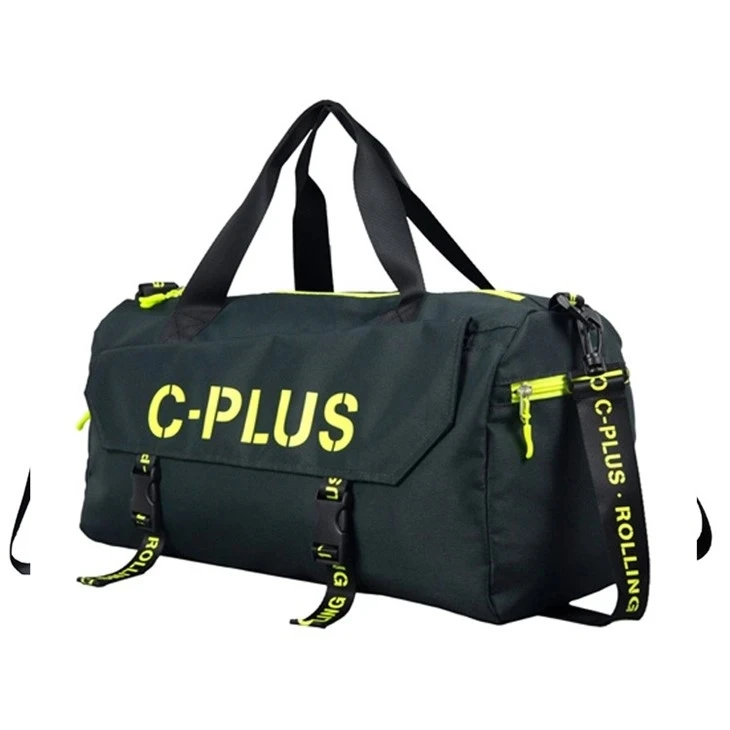
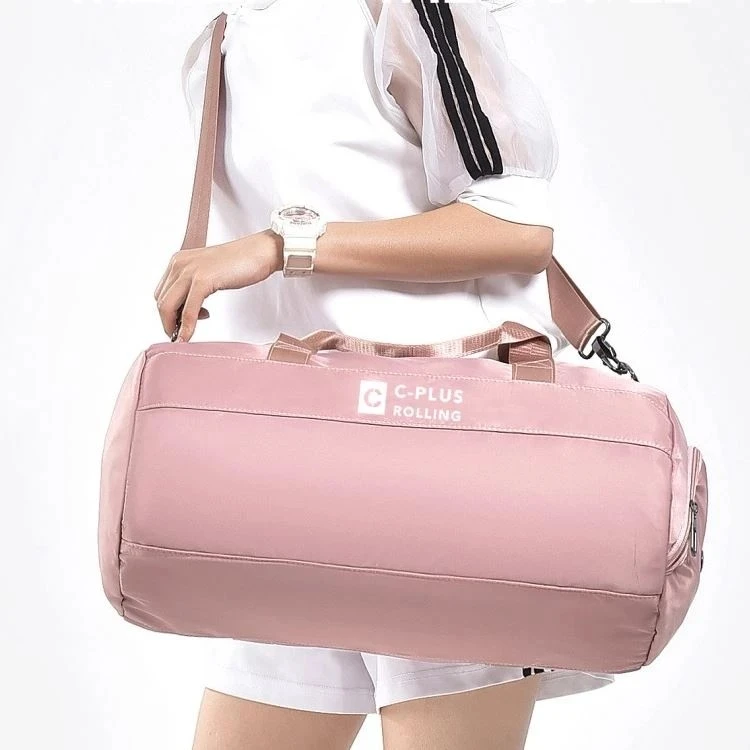
The load-mode decision has a break-even worth memorizing. Below 15 CBM, LCL is cheaper; between 15 and 22 CBM the two are close enough that destination CFS and terminal charges decide it; above 22 CBM a full container wins; above 28 CBM the 40HQ is the only option. The duffle and gym bag ranges illustrate the point in practice, since one ships as compressed soft volume and the other carries rigid panels that do not compress.
Shared Materials: Where Consolidation Cuts Cost Without Cutting Specs
Fabric is the hidden MOQ ceiling in any bag program. Custom fabric usually starts at 1,000 to 1,200 meters per color, against one meter for stock goods, so a small SKU can be blocked not by sewing capacity but by a dye lot. Consolidation works when it converges on a small number of fabric families rather than forcing every product onto one cloth.
Three families cover most outdoor programs. A 600D PU oxford handles duffels, organisers, and packables. A 420D nylon with PU or TPU coating at 5,000 to 8,000 mm hydrostatic head covers pack bodies, dry bag shells, and bases where water resistance matters. A 210D, 100D, or 40D siliconized cloth serves ultralight bodies, rain covers, and liners. Ordering these three families once across a whole program turns "every SKU needs its own dye lot" into "the program fills three dye lots," and cutting the color card from eight to twelve shades down to four to six finishes the job.
Hardware discipline matters as much as fabric. One zipper family at two or three sizes, one or two buckle suppliers, webbing in three widths, and a single salt-spray standard for metal parts means one set of incoming inspections and one spare-parts bin. Every extra hardware SKU is an extra stocking decision, an extra line stoppage risk, and an extra reason a replacement part cannot be found two years later.
The line to hold is specification. Consolidation should reduce the number of materials rather than the performance of any one of them. If a program moves a base panel from 900D to 600D to match the body, that is a specification change and should be priced and disclosed as one, not presented as a sourcing win. Material and process options at the factory level are documented on the service page, and the safe rule is simple: share the family, keep the grade.
MOQ Aggregation: Building a Program Below Per-Item MOQs
MOQ exists because setup costs exist: a dyed lot, a print screen per color, a zipper ordered to length, a line stopped for a changeover. Understanding the reason is what makes negotiation possible, since the lever is almost never "give us a lower minimum" but "here is how the setup cost gets absorbed."
Four levers stack. The first is combining SKUs into one purchase order, since five styles at 100 pieces each is a 500-piece order to a factory that plans by total volume. The second is negotiating against fabric meters rather than unit counts, which can move a threshold by 30 to 50 percent when the styles share a cloth. The third is splitting production across colors in a way the factory can schedule, accepting a longer delivery window in exchange for a lower entry quantity. The fourth is choosing an existing pattern over a new one, because a new pattern carries development and sampling cost that a modified stock style does not.
Benchmarks help set expectations. Simple canvas items can start near 100 pieces per style per color; small structured bags with hardware run 100 to 200; backpacks with suspension and a laptop compartment start around 200 to 300; promotional nylon bags land in the same band because fabric minimums, not sewing, set the floor. Two factories quoting 150 and 500 for the same brief are usually quoting different amounts of customization, not different levels of greed.
What makes aggregation work in practice is disclosure. A buyer who states the two-year plan, the number of SKUs per season, and the target reorder volume gives the factory something to amortize against, and that is how a conversation with an outdoor sports bag manufacturer china supplier moves below the printed minimum. A buyer who asks for 80 pieces and mentions no future is asking the factory to absorb the setup cost, and the quote will reflect that. Consolidating suppliers is ultimately a negotiation about information as much as about price, and the buyers who get below-minimum runs are the ones whose next three orders are visible.
Design Reflection
Mixed-container sourcing is not a discount tactic. It is a design constraint applied one level up: the same discipline that decides which panel gets 1000D decides which product goes on which line, which carton goes where in the container, and which materials are shared across a season. Programs that skip that level do not fail loudly; they simply carry a cost nobody can attribute.
The useful habit is to keep three numbers for every SKU: cubic meters per unit, meters of each fabric consumed, and the MOQ that the fabric forces. With those three visible, a mixed order becomes arithmetic, and arithmetic can be argued with before the deposit rather than after the shipment.
Final Thoughts
One factory does not make everything, and one container does not care what it carries. A mixed outdoor bag program works when the line allocation follows construction, the container plan follows cubic meters, the materials converge on a few families without downgrading any of them, and the MOQ conversation with the outdoor sports bag manufacturer china plant is backed by a real forecast. Those four moves are what turn a scattered supplier list into a program.
Goldenway(Xiamen Goldenway Enterprises Co., Ltd.)has manufactured bags since 1999. The company operates an 18,000 ㎡ factory in Xiamen with monthly capacity of 80,000–150,000 pieces and provides OEM/ODM service under Sedex 4.0 and Disney FAMA certification, as reported by the company. Programs combining suspension packs, duffels, and accessories can be quoted as a single mixed order with carton data per SKU.