Diaper Tote vs. Diaper Backpack
Leave a message
Ask ten parents which diaper bag format is better and you will get ten answers. Ask a retail buyer the same question and the answer becomes measurable: it depends on the channel you sell through. A shelf audit of one of Germany's largest maternity chains in November 2026 counted 138 tote SKUs against 81 backpack SKUs - the offline channel stocks totes at nearly twice the depth of backpacks. Meanwhile, marketplace bestseller lists in the same market skew clearly toward backpacks.
This guide breaks the diaper bag tote vs backpack question down the way a sourcing decision actually needs it: by channel, by price band, and by use scenario. It is written primarily for buyers targeting European markets, with North America as a contrast case. As a custom diaper bag manufacturer producing both formats, we will also show what each format means for your bill of materials, your MOQ, and your freight bill.
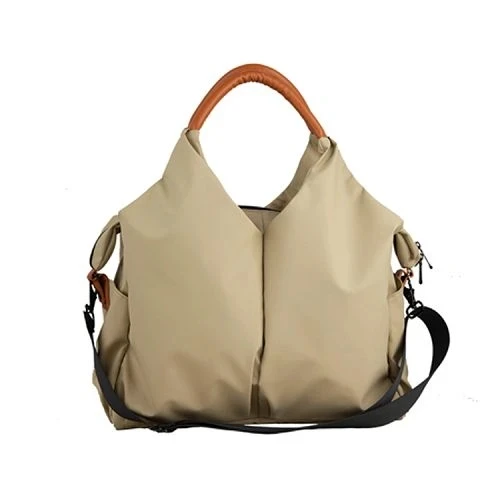
Short Answer: Channel Decides Format
1. Maternity chains stock totes first. Offline chains build their diaper bag walls around totes; backpacks fill a secondary position at a higher median price.
2. Marketplaces and travel retail favor backpacks. The "hands-free" search intent, the airport scenario, and price-driven browsers all push online demand toward backpacks.
3. Convertible designs are the premium compromise. A tote with hidden backpack straps, or a backpack with grab handles, covers both shelf positions at the highest unit cost.
If your roadmap forces a single format, match it to your primary channel rather than to a trend chart. If you can run both, the format question turns into a portfolio question, and that is where the margin lives.
Market Split: What European Shelves Actually Show
The most reliable public signal for baby bag market demand is not a market report (reliable category-level figures simply do not exist for free) but the shelf itself. Our November 2026 sampling of German maternity retail gives a concrete picture:
• BabyOne (one of Germany's largest maternity chains, online plus roughly 130 stores): 138 SKUs in its Wickeltaschen (tote) category versus 81 in Wickelrucksäcke (backpacks), a ratio of 1.7 to 1. Median tote price about €99.99; median backpack about €119.99.
• babyartikel.de (German baby e-tailer): prices cluster at €79.90–129.95 with a median near €99.90, and the category itself splits into totes / backpacks / pouches.
• Across both channels, the mid-market battleground is €80–130; entry backpacks start near €35; almost nothing above €200 appears in mainstream German maternity retail.
Two structural observations follow. First, European maternity chains are anchored by players such as BabyOne and Prenatal plus strong regional chains; pure baby e-tailers have been ceding ground to general marketplaces and chain webshops. Second, gifting is a visible part of the offline journey (gift-guide navigation appears directly on chain websites), which explains why the tote, with its handbag-like appearance, holds its shelf position.
The North American contrast. US-led brands cluster their mainstream offer around $50–100, and industry consensus puts a higher backpack share online there. European mid-market pricing (€80–130, roughly $90–140 at current rates) sits above it. The practical takeaway for a buyer planning both regions: Europe rewards a stronger tote and gifting story at higher unit prices; North America rewards a sharper, more affordable backpack.
Carry Ergonomics: One Hand on the Baby, One Hand Free
The ergonomics argument is the heart of any diaper backpack comparison, and it starts with an honest observation: parents rarely have two free hands. A tote's wide top opening, whether magnetic snap or open-top, lets you fish out a diaper one-handed while holding the baby. A backpack usually needs a shoulder strap off the shoulder, or a spin-and-side-zip maneuver, before the first zipper moves.
On load distribution, the principle is well established: symmetric two-strap carrying beats single-shoulder carrying, and pediatric guidance on school bags (keep the load light, use two wide padded straps, keep weight close to the back) transfers to adult bags as a principle. A fully loaded 20–25 L diaper bag typically runs 3–5 kg; for most adults that works out to roughly 5–8% of body weight, well within comfortable range. That is exactly why the backpack works so well for long days out.
There is also a third carry mode that European data keeps surfacing: the stroller. Our shelf sampling found universal stroller clips and buggy organizers sold as standalone SKUs right inside the tote category. In stroller-dense European cities, tote-plus-clips covers the walk, while the backpack covers car-free trips without a stroller. The two formats overlap less than category pages suggest.
Same Liters, Different Layout
Most mid-market diaper bags claim 18–25 liters regardless of format. What differs is how that volume is organized:
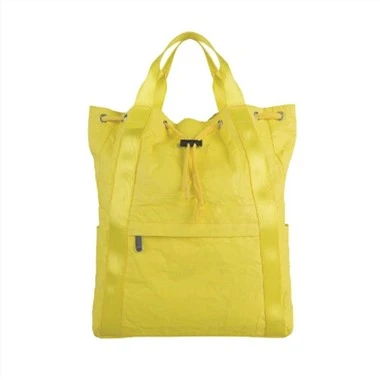
• Tote: a shallow, wide main compartment you can see into from above. Retrieval works by sight, which pairs naturally with one-handed access. Structure depends on a base board: without it, the bag slumps on the shelf and in product photos.
• Backpack: a deep main compartment that hides contents from view, which is why nearly every diaper backpack adds a U-shaped front opening, side zips, or a two-compartment split to recover accessibility.
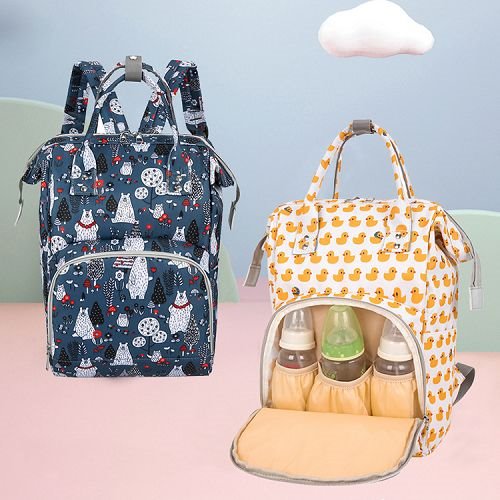
• Insulated bottle pocket placement follows the same logic. Totes tend to mount it on the outside sidewall, reachable while the bag hangs on a stroller. Backpacks put it front-and-vertical or as an internal divider, because the wearer can only rely on position memory.
For gifting, the formats tell different stories. A well-finished tote reads as a handbag first and a diaper bag second, a safer gift for someone you do not know well. A backpack is deliberately neutral, which makes it the shared bag for both parents. Retailers use exactly these two scripts on their shelf talkers.
BOM, MOQ, and Freight: What Each Format Costs You
Format choice is also a cost decision. The bill-of-materials difference is structural, not cosmetic:
• A tote needs: two handles, one detachable shoulder strap, and a base board. The board is the rigid cost item: the bag must stand up for hook displays and for e-commerce hero shots.
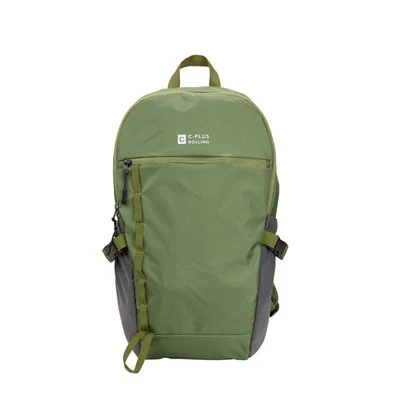
• A backpack needs: an S-curve strap system with mesh padding, a sternum strap (often a waist strap too), a back panel, and roughly 30–60% more webbing, hardware, and seam length than the equivalent tote.
• Net effect (factory experience range, confirm at quotation): material cost up about 10–20%, sewing time up about 15–30% for the backpack, before any printing or embroidery.
Freight amplifies the difference. A boxed 20–25 L diaper bag occupies roughly 0.03 CBM (about 35×20×45 cm). Soft construction allows flat-packing, and unboxed bulk cartons can save roughly 30–50% of the volume; the estimate depends heavily on how rigid the base board and back panel are. For Amazon FBA Europe, volumetric weight (L×W×H in cm ÷ 5000, compared against actual weight) decides the fee tier, so carton thickness directly moves your landed cost.
One more line item buyers miss: packaging differs by channel. Chain retail displays totes on hangtags and can skip the carton; marketplace listings need one. Quote the two channels separately or the packaging delta will eat your margin on one of them.
Compliance adds a small format asymmetry worth knowing early. Totes are the format that most often ships with detachable accessories (teether clips, stroller hooks, soft mirrors), and in Europe any detachable toy pulls the whole product into EN 71 testing scope; a plain backpack usually stays outside it. Two more items now show up routinely in European RFQs regardless of format: PFAS-free water-repellent finishes (buyers are front-running a restriction proposal that has not yet taken effect) and German packaging registration (VerpackG / LUCID) for anything shipped direct to German consumers. None of this changes the format decision by itself, but it changes the sampling checklist.
Returns deserve a mention too, because no reliable category return-rate exists publicly. Work from return reasons instead. The recurring ones for diaper bags are: capacity that mismatches the product photos (no reference object in the listing), a tote bought for commuting that turns out to have no shoulder strap, a backpack whose one-handed access disappoints, and strap discomfort on either format. Every one of those is a spec-sheet problem you can fix before production, and the fix is cheaper than the return.
Which Format to Stock: A Decision Matrix
Condensing the diaper bag tote vs backpack question into a working matrix:
|
Your situation |
Best format |
Why |
|
Selling into maternity chains (BabyOne / Prenatal type) |
Tote |
138 vs 81 shelf depth (first-hand count); median €99.99; gifting traffic |
|
Selling on Amazon EU / marketplaces |
Backpack |
"Wickelrucksack" search intent, hands-free story, €40–90 main battleground |
|
Building a brand D2C line above €130 |
Convertible |
"One bag, three carries" justifies the premium; supports dual-format color stories |
|
Entry price band below €80 |
Backpack |
The tote's base board is a rigid cost; backpacks start near €35 |
|
Stroller-heavy urban market |
Tote + stroller clips |
Clips and buggy organizers are proven standalone SKUs |
|
Gifting-heavy assortment |
Tote |
Handbag-first appearance; neutral backpacks serve as the shared-purchase alternative |
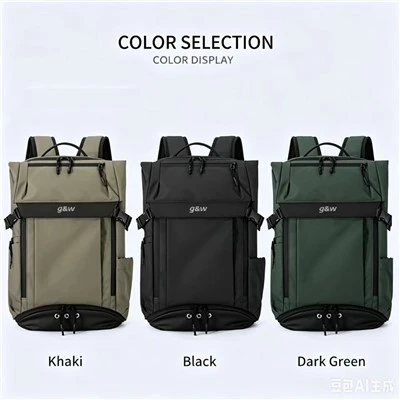
Treat the two formats as complements on the same casual bags roadmap rather than as competitors. German chains already merchandise same-color tote and backpack versions of one design side by side, and that dual-format, single-colorway strategy is the cleanest way to cover both shopper types with one development budget.
Working With a Manufacturer on Both Formats
The cheapest way to add a second format is to develop it alongside the first: shared fabric batches, shared hardware, and a pattern family that keeps the silhouettes visually related. Convertible designs (hidden straps, stowable handles) cost the most per unit and only pay back above roughly the €100 retail line, so they belong at the top of the range, not in it.
The convertible approach is not theoretical. In our German shelf sampling, one leading local brand sells a tote with hidden backpack straps and a backpack with grab handles under the same "Up" series name, and merchandises the same design as a tote and a backpack in matching colorways side by side. That is the pattern to copy: one pattern family, two formats, one color story.
When you brief us, tell us the channel first and the format second. We will come back with a layout proposal, a base-board or back-panel specification matched to your price band, and packaging options split by retail channel. Then you can request samples of both formats in the same colorway and test them against each other on a real shelf or a real listing.

Can one factory produce tote and backpack versions of the same design?
Yes, and it is the efficient way to run the category. The two formats share fabric, hardware, and most trim; only the carrying system and the structure elements (base board vs back panel) differ. We typically develop them as one pattern family so the colorways stay aligned across both formats.
What MOQ should we plan for a convertible diaper bag?
Convertible designs carry the highest component count of the three formats, so their MOQ sits above a plain tote and roughly at or above a backpack program. The practical approach is to confirm the hardware set (hidden strap hardware is the long-lead item) before locking quantities. As with all OEM projects, MOQ is confirmed against your final specification at quotation.
Do tote diaper bags carry extra compliance risk from toy attachments?
They can. Detachable toys such as teether clips, soft mirrors, and hanging characters pull the product into EN 71 testing scope in Europe and ASTM F963 in North America, and totes are the format that most often ships with such accessories. If your assortment includes them, plan the testing at development stage, not after production.